"The [RTM] money will not pay for service expansion," BART communications manager Alicia Trost told The Oaklandside the week after Bay Area voters approved the Regional Transit Measure. For anyone deciding between Orinda, Lafayette and Moraga with a train commute in mind, the November vote kept the trains you can ride this week from being cut. It also means those trains are, for practical purposes, the service you should expect to have for years.
Before Nov. 3, a household weighing an Orinda address had to consider that the station might close. Now that question is settled, and buyers can plan around a different fact: what Lamorinda's BART service looks like in late 2026 is close to what it will look like in 2032.
The Plan That Did Not Happen
In February, BART staff took the board through a "Measure Fails" budget framework. It was a detailed outline of what the system would become without new regional money. The February 12, 2026 workshop presentation proposed that in January 2027 BART would close its ten lowest-ridership stations, ranked by 2025 ridership, and Orinda was one of them. The same Phase 1 plan would have cut train hours by 63%. It would have run three lines with two trains an hour on each, limited peak Yellow Line trains to the peak hour and direction, closed the system at 9 p.m. seven days a week, and opened at 8 a.m. on weekends. A second phase, planned for July 2027, would have ended Yellow Line service at Concord.
The same presentation described the service running at the time as the baseline. That was a Yellow Line train every 10 minutes on weekdays and evening service until midnight. For a Lafayette commuter, the gap between the two plans is the gap between a train every 10 minutes and one every 30, and between a late dinner in the city and a 9 p.m. last train.
Orinda's place on the closure list was also a campaign point. The argument in favor of Measure RTM printed in Contra Costa County's voter materials warned that BART cuts "could close the Orinda, North Concord, Pittsburg-BayPoint, and Antioch stations." That was the argument for a yes vote, written by the measure's supporters. BART's own February document is the record of what the agency was actually prepared to do.
What the Vote Fixed in Place
The measure passed in all five counties where it was on the ballot. In Contra Costa, the county's unofficial update of Nov. 20 showed 57.56% yes and 42.44% no, with all 951 precincts reporting. The regional result was wider. MTC's preliminary count on Nov. 9 put the five-county total at 63%. Lamorinda Weekly's Nov. 11 election roundup noted that Orinda station had been named as at risk.
BART expects the measure to bring in about $310 million a year. According to The Oaklandside, Trost said the money will mainly pay for current service. It replaces emergency state funds that run out in the next few months. She also said BART cannot run beyond its current hours because it needs that overnight window for maintenance. Its Communications-Based Train Control project, which is meant to let trains run more often eventually, locks in current service hours until the project is finished, expected by January 2033.
For someone house-hunting, this makes BART service a known quantity. A Monday-morning trial run from Lafayette or Orinda this winter is a fair preview of the trip you would be making for the next several years, since nothing in the agency's statements points to more frequent trains or later service from these stations before the train-control work is done.
The Budget Behind the Trains
BART's funding has also changed shape. The Oaklandside's summary of BART's Nov. 12 board presentation says the tax will cover about 56% of the agency's operating budget. Fares once made up as much as 70% of BART's revenue. Ridership from stations like Orinda still matters, but the system no longer depends on fares the way it did when the February closure plan ranked stations by how many people used them.
The Nov. 12 board presentation still projects operating deficits even with the measure in place: $28 million in fiscal 2028, $39 million in fiscal 2029, $38 million in fiscal 2030 and $19 million in fiscal 2031. Those gaps are small next to the shortfall the February plan was written to close. BART's staff report also named economic conditions, cost pressures and possible litigation over the measure as risks. The agency says it would borrow to keep service running if the measure is challenged in court. A buyer can treat the station staying open as settled and treat future frequency as something BART says it is protecting, which is about as much as any transit agency promises.
What the Commute Costs, and Starting When
Two costs apply to a Lamorinda BART commute, and they arrive on different schedules.
The fare is already set. BART raised fares by an average of 6.2% on Jan. 1, 2026. Under the fare table in effect since that date, a one-way trip from Orinda to Montgomery Street costs $5.95 and a one-way trip from Lafayette to Montgomery Street costs $6.50. Orinda is the station closer to the city, and the 55-cent difference adds up to $1.10 a day for a five-day San Francisco round trip. For households comparing one side of the Lamorinda line with the other, that is a small but recurring cost.
The tax starts next spring. KQED reports that the Regional Transit Measure adds a 0.5% sales tax in Contra Costa County for 14 years beginning April 1, 2027, raising the county's base rate from 8.75%. These figures are general information, not tax or financial advice. Confirm how they apply to your household with a qualified professional.
Three Towns, Two Stations
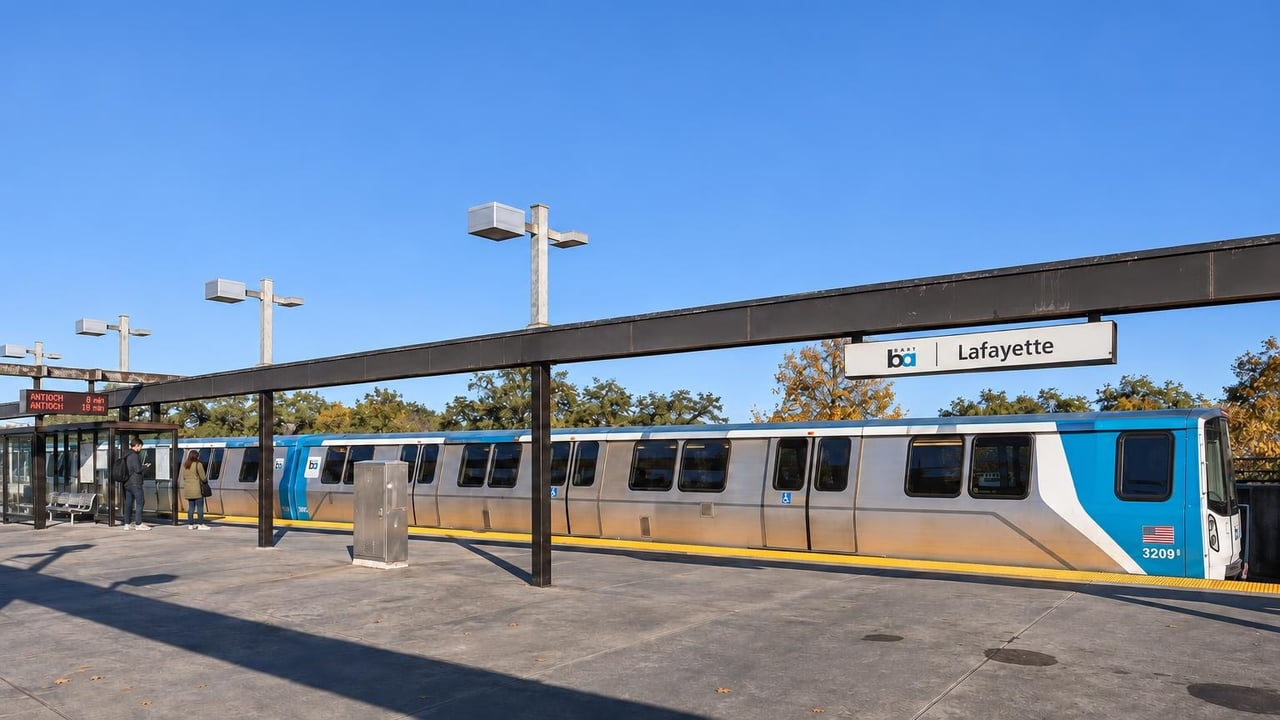
Lamorinda's commute depends on which town you choose. Orinda and Lafayette each have a station on the Yellow Line along Highway 24. Orinda's station is the one that appeared on the February closure list, and it is now set to keep the service it has. Lafayette's station was not on that list.
Moraga has no station, so a train commute from there starts with a drive or a bus. County Connection's Route 6 runs between Lafayette BART, Saint Mary's College, Moraga and Orinda BART. Its posted weekday schedule runs from about 6:15 a.m. to 8 p.m. with buses every 30 to 60 minutes, and weekend service runs from about 10 a.m. to 5:30 p.m. at 80-minute intervals. The Route 6 schedule ends around 8 p.m. on weekdays, while trains run until midnight, so a Moraga household that wants to come home late should plan on a car for the trip from the station.
The vote changes how a buyer should compare these towns. Before Nov. 3, an Orinda address came with a real chance that its station would lose service. That risk is now off the table, and Orinda's trip to Montgomery Street is the cheaper of the two. Lafayette has the same Yellow Line trains at a slightly higher fare. Moraga's train commute depends on a bus schedule or a parking plan at one of the two stations. All three are now stable, and none of them is set to get more frequent service before 2033. The commute you can test this winter is a sound basis for the decision. For a broader look at how the three towns fit together, see our Lamorinda overview.
A Few Questions Buyers Raise
Is Orinda BART still at risk of closing? The closure was part of BART's plan if the measure failed, and the measure passed. BART has said the new revenue will preserve current service.
Will trains run more often or later now that the measure passed? BART told The Oaklandside the money will not fund expansion and that current hours are locked in until the train-control project is finished, expected by January 2033.
When does the new sales tax show up on receipts? KQED reports a start date of April 1, 2027, in Contra Costa County.
When the BART commute decides which town you live in, the choice comes down to the address and how it connects to the station. At The Beaubelle Group, we are glad to talk through how a specific property fits the trip you will be making. Reach out to our team to start that conversation.